Midwest Book Review doesn't review every book it receives. And, depending upon the reviewer, the reviews can on occasion appear hasty and based upon the dust jacket. Still, they are always welcome.
This line from a recent review of Jim Hessler's outstanding (and award winning) Sickles at Gettysburg struck my eye:
"No one in the Civil War was a saint, but some were further from sainthood than others."
OK, someone was drinking their coffee that morning and hitting on all cylinders.
It concludes with, "Sickles at Gettysburg is not a read to be missed."
We agree. Hence the Bachelder-Coddinton Award for the best book on Gettysburg in 2009--and a selection by the History and Military Book Clubs.
This book is new in paperback (although we might have a dozen or so first edition hardcovers left with signed book plates--best pick one up if you want a book that will be a collector's item).
Congrats, Jim.
--tps
Tuesday, July 20, 2010
Friday, July 16, 2010
Gunny Pop Discusses "The Cartoon" and Meets PINCH on Fox's Red Eye
I love watching and listening to Greg Gutfeld, the quirky and extremely sharp host of Fox's Red Eye.Like a decent cigar or aged Scotch, he is an acquired taste, but once you "get it," you . . . get it. And you like it.
Click HERE to see Greg interview Nick "Gunny Pop" Popaditch the other night about "The Cartoon" that appeared in the Imperial Valley Times, and much more.
Click HERE to see a creative alternative view of "The Cartoon" by one of the readers:
Stick around to the end, and you get to see PINCH, a talking newspaper spoof of Pinch Sulzberger of the New York Times. It is hilarious--especially when the talking newspaper asks Nick, "Can we take a look at your eye for the science section."
Off mike after the show, Greg invited Nick for the entire hour as an in-studio guest/commentator, and since Nick and I both have business in new York and Washington D.C., it looks like we will be flying out to NYC and DC for a week in August.
Spending time with Gunny is always enjoyable. But . . . DC in August? With a former drill instructor? Let me rethink that . . .
--tps
Nice Interview with Tom Clemens, Editor of Carman's The Maryland Campaign

Click here to read an in-depth interview with Dr. Clemens, especially if you enjoy learning about the Maryland Campaign. Well worth five minutes.
Thanks Harry.
Tuesday, July 13, 2010
Newspaper Apologies, Filner Finally Condemns . . . and the Story Grows
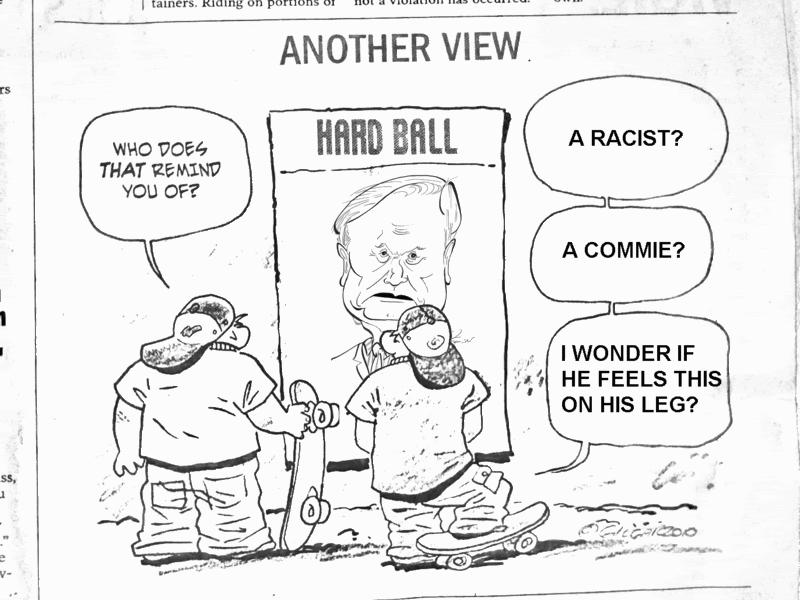
Yesterday, I wrote a post about how The Imperial Valley News seemed to openly mock a veteran's war wounds through a cartoon, now known as The Cartoon. At least that was the opinion of nearly everyone who has viewed the cartoon. The carton was about one of our authors (and now my good friend Nick Popaditch, Once a Marine).
The news spread like wildfire, from the Los Angeles Times and San Diego Tribune, San Diego TV, National Review, Mick Huckabee, Michelle Malkin, Editor & Publisher Magazine, Redstate, and about 100 other sites. My Google alerts were coming in every few minutes. They are still coming in as I write.
Nick was inundated with radio and media requests, the editor of the paper called him to apologize and has now published the apology, and after stalling and hemming and hawing and telling callers he had "No comment" [NO COMMENT?], Congressman Bob Filner (who Nick is running against for a Congressional seat) finally found his cahones and condemned the newspaper for publishing a denigrating cartoon of a veteran.
Now there is a bit of back story. Imperial Valley (highest unemployment in the nation, large Hispanic population, agricultural, and suffering) has always been a strong spot for Nick's opponent, incumbent democrat Bob Filner. Nick, however, is Filner's first real challenger--ever. And he is an everyday Joe who served 16 years in the Marine Corps, earned a Silver Star, commanded a tank, and was critically wounded for his country. And people love him. He walks the agricultural fields, sits in the cafes, and goes door-to-door--waging the kind of aggressive "boots on the ground" campaign a Marine would undertake that Filner never has and never could. And Filner is now losing Imperial Valley.
The other night, right before The Cartoon came out, Nick spoke to a large townhall meeting out in the Valley. He invited Filner to attend and "answer questions with him." Filner initially agreed, and then backed out. Nick spoke for hours to hundreds of people, remaining until every single question was answered. He was applauded, congratulated, and the people there had never seen anything like it.
AND THEY LOVE HIM.
And the next day, the newspaper runs The Cartoon.
Are Filner's fingerprints on this? I don't know. We do know that in an earlier fundraising letter, Filner said that Nick has "absolutely no qualifications to hold public office." Now think about that: 16 years in the corps, extensive combat experience, as a gunnery sergeant he organized, executed, handled logistics, and commanded men in life and death situations--and he is not qualified for public office? What an elite snob.
Filner is afraid of Gunny Pop. And he has every reason to be.
If you have not read Nick's book Once a Marine, I respectfully suggest you do so. It will change the way you look at the world and your own life. I guarantee it or I will refund your money.
And if you want to throw a few bucks Nick's way, help him out by clicking here.
--tps
The news spread like wildfire, from the Los Angeles Times and San Diego Tribune, San Diego TV, National Review, Mick Huckabee, Michelle Malkin, Editor & Publisher Magazine, Redstate, and about 100 other sites. My Google alerts were coming in every few minutes. They are still coming in as I write.
Nick was inundated with radio and media requests, the editor of the paper called him to apologize and has now published the apology, and after stalling and hemming and hawing and telling callers he had "No comment" [NO COMMENT?], Congressman Bob Filner (who Nick is running against for a Congressional seat) finally found his cahones and condemned the newspaper for publishing a denigrating cartoon of a veteran.
Now there is a bit of back story. Imperial Valley (highest unemployment in the nation, large Hispanic population, agricultural, and suffering) has always been a strong spot for Nick's opponent, incumbent democrat Bob Filner. Nick, however, is Filner's first real challenger--ever. And he is an everyday Joe who served 16 years in the Marine Corps, earned a Silver Star, commanded a tank, and was critically wounded for his country. And people love him. He walks the agricultural fields, sits in the cafes, and goes door-to-door--waging the kind of aggressive "boots on the ground" campaign a Marine would undertake that Filner never has and never could. And Filner is now losing Imperial Valley.
The other night, right before The Cartoon came out, Nick spoke to a large townhall meeting out in the Valley. He invited Filner to attend and "answer questions with him." Filner initially agreed, and then backed out. Nick spoke for hours to hundreds of people, remaining until every single question was answered. He was applauded, congratulated, and the people there had never seen anything like it.
AND THEY LOVE HIM.
And the next day, the newspaper runs The Cartoon.
Are Filner's fingerprints on this? I don't know. We do know that in an earlier fundraising letter, Filner said that Nick has "absolutely no qualifications to hold public office." Now think about that: 16 years in the corps, extensive combat experience, as a gunnery sergeant he organized, executed, handled logistics, and commanded men in life and death situations--and he is not qualified for public office? What an elite snob.
Filner is afraid of Gunny Pop. And he has every reason to be.
If you have not read Nick's book Once a Marine, I respectfully suggest you do so. It will change the way you look at the world and your own life. I guarantee it or I will refund your money.
And if you want to throw a few bucks Nick's way, help him out by clicking here.
--tps
Monday, July 12, 2010
Media Makes Fun of Wounds suffered by Marine Nick "Gunny Pop" Popaditch
The Imperial Valley Press (El Centro, California), which operates in the 51st Congressional District in California (right on the Mexican border, including part of San Diego), ran the cartoon reproduced here. Uncle Fester? A bald pirate? Drawing and than publishing an editorial cartoon like this is not only beyond contempt and sickening, but it screams out that someone thinks that Nick's campaign is serious, and that he might well derail the reelection of Bob Filner. Nick is the first real challenger Filner has ever faced.
CLICK HERE for a full article on Nick and the cartoon. Feel free to pass it along, and post on your own blog and/or tweet it.
Nick is also the author of Once a Marine: An Iraq War Tank Commander's Inspirational Memoir of Combat, Courage, and Recovery (Savas Beatie, 2008), and the recipient of the Silver Star.
Regardless of your politics, we believe that making fun of veterans who were critically wounded in the service of OUR country, is just wrong.
Arguing ideas and policy is one thing; making fun of the someone's loss of his eyes (yes, Nick lost one completely and 92% of the vision in his remaining eye and he is essentially deaf in his right ear after being hit in the head with a rocket after 36 hours of continuous combat in Fallujah), is simply despicable and demands a retraction.
Please let the The Imperial Valley Press know that you think the same thing.
Editor Brad Jennings: 760-337-3425
CLICK HERE TO EMAIL THE EDITOR
or copy and paste this address: editor@ivpressonline.com
BOB FILNER--WHERE ARE YOU?
We also call upon Bob Filner (D), who sits on the Veterans' Affairs Committee (which includes medical treatment), should immediately demand that that The Imperial Valley Press issue a public retraction and apology to Gunny Pop.
Contact Bob Filner here and let him know:
California Offices:
333 F Street, Suite A
Chula Vista, CA 91910
Phone: (619) 422-5963
Fax: (619) 422-7290
1101 Airport Road, Suite D
Imperial, CA 92251
Phone: (760) 355-8800
Fax: (760) 355-8802
Washington, DC Office:
Bob Filner
2428 Rayburn House Office Building
Washington, DC 20515
Phone: (202) 225-8045
Fax: (202) 225-9073
--tps
Thursday, June 24, 2010
E-Books--What's the Rush? A Contrarian's Take
This fascinating article appeared in my email a few days ago, and I thought it was worth sharing with readers and publishers alike. Enjoy. --tps
--------
Dear Indies,
As a fellow independent book publisher, I can’t help but wonder why I haven’t been affected one way or another by the current e-book revolution that so many of the articles I’ve read assure me is underway. After considering all the hype I’ve read about, I realized that all the parameters for these e-book discussions are being set by those who have financial interests in servicing those indies who wish to jump into the world of digital book downloads. I’m certain that e-book evolution will become an important factor one day; but to my way of thinking, it isn’t today. Because of this, I wrote a column on the topic that was in this month’s issue of Book Business magazine. For those of you who would like to see a less biased take on the topic, I invite you to read my article below.
THE 500 POUND E-BOOK, by Rudy Shur
In many industries, there is a moment that changes everything. For the horse-drawn carriage manufacturers, it was the invention of the automobile. For the telegraph company, it was the telephone. For the music industry, it was mp3 downloads. And for book publishers, it appears to be the e-book—or is it? If I were an outsider looking in at our business, it would seem to me that the e-gorilla has indeed entered the room. All you have to do is read the continuing stream of news stories that deal with the “spectacular” growth of the e-book market—that herald the latest of the Kindle or the introduction of Apple’s iPad—and it would seem that the industry is being turned upside-down. Pity the poor publishers who get left behind clinging to their old-fashioned paper books, because their days are numbered. Or at least that’s what some prognosticators would have you believe.
As someone who has spent more than thirty years in this business, I have a rather different take on the subject. Now granted, if I had been building buggies, I might have considered manufacturing a few of those new-fangled horseless carriages, and if I had owned shares in Western Union, I would have hedged my investment by picking up some AT&T stock. But book publishing is a very different animal, and because of that, I don’t think that our future is as uncertain as many now claim it to be.
Let’s look at the facts. At this time, approximately 3% ($200 million) of total book market revenue ($80 billion) comes from e-book sales. Experts estimate that this number could double over the next two years. Let’s say that in five years, the number triples. This would mean that 18% ($1.2 billion) of market revenue would come from e-book sales, and 82% ($78.8 billion) would still come from books on paper. That certainly would impact our sales, but it would hardly spell the end of the book world as we know it.
To better evaluate the impact of e-books on our industry, it’s important to understand the types of books that are being purchased in electronic form. Strangely, few studies have detailed exactly what books are popular as e-titles. General estimates indicate that e-textbooks represent about 15% of the overall e-market attributing the balance of sales coming from trade titles. But what kinds of trade books are favored by e-book readers? After conducting my own very informal interviews of people who own e-readers, I discovered that almost without exception, e-book readers buy bestsellers. I could not find one person who routinely buys reference or scholarly titles in electronic form. So how does that answer impact the independents?
For argument’s sake, let’s be kind and say that 80% of all trade books sold are bestsellers. The fact is that only twelve publishing companies represent the bulk of all best-selling titles. That leaves a paltry 20% of sales to be divided among the remaining tens of thousands of mid-sized, small, mini, and self-publishers out there. In dollars and sense, that’s not really enough income to sustain a mid-sized house. What that does indicate is the necessity for a major shift in economic strategies for those twelve trade houses. For the rest of us, at least, the pressure is not that great to shift gears immediately. And exactly what do I mean when I refer to shifting gears? I’m talking about independents stampeding to get their electronic book files turned into e-books.
What irks me the most are the dozens of new technology companies and websites that have sprung up to help us poor indies deal with the coming demand for e-books. These folks apparently are the “experts” in the field. After all, they give forums, workshops, and seminars. And they all repeat the same mantra. Convert your books now, before it’s too late. What, you don’t have an e-book program? And you call yourself a publisher? Shame on you, but don’t worry. For a few hundred dollars or a big percentage of your book’s revenue, we will gladly bring you into the Twenty-First century. For me, at least, the answer is, “Thank you, but no thank you.”
Currently, a variety of different electronic platforms are being used by competing e-book readers. This is akin to the video wars that once raged among producers of Betamax, VHS tapes, and laser disk formats. Electronic book technology is moving so rapidly that it’s impossible to know where the dust will settle. And based upon my meager e-book income as described above, I see no major gain to jumping into what appears to be a Wild West show. Personally, I’m also not too keen on giving up 50% of my revenue to have my titles converted into e-books for free. To my way of thinking, that would cheat my authors and hurt my company’s bottom line. For independents, the existing e-business environment clearly gives preference to the converters and e-book distributors. I believe that it is just a matter of time that numerous publishing partners and services will emerge to shift the balance more in our favor. When it does come to pass—and it will—there will be better options to choose from and time enough to make informed decisions.
As I see it, independent publishers are spending too much time worrying about the future impact of e-books, and are spending too much money partnering up with companies that are more hype than substance. We all know that change is coming. By 2025, technology will be providing us with new gadgets to run our businesses and sell our books, and e-books will be a significant part of the book trade pie. But right now, we independents need not worry about missing out on the imaginary wealth that awaits us in the e-book market. What we need to do is keep our eye on producing titles for the 97% that comprises the traditional markets. When the time is right to make the move it e-books, we’ll know it.
So, is there an e-gorilla in the room? Sure, there is. But it’s a lot smaller than you think.
--------
Dear Indies,
As a fellow independent book publisher, I can’t help but wonder why I haven’t been affected one way or another by the current e-book revolution that so many of the articles I’ve read assure me is underway. After considering all the hype I’ve read about, I realized that all the parameters for these e-book discussions are being set by those who have financial interests in servicing those indies who wish to jump into the world of digital book downloads. I’m certain that e-book evolution will become an important factor one day; but to my way of thinking, it isn’t today. Because of this, I wrote a column on the topic that was in this month’s issue of Book Business magazine. For those of you who would like to see a less biased take on the topic, I invite you to read my article below.
THE 500 POUND E-BOOK, by Rudy Shur
In many industries, there is a moment that changes everything. For the horse-drawn carriage manufacturers, it was the invention of the automobile. For the telegraph company, it was the telephone. For the music industry, it was mp3 downloads. And for book publishers, it appears to be the e-book—or is it? If I were an outsider looking in at our business, it would seem to me that the e-gorilla has indeed entered the room. All you have to do is read the continuing stream of news stories that deal with the “spectacular” growth of the e-book market—that herald the latest of the Kindle or the introduction of Apple’s iPad—and it would seem that the industry is being turned upside-down. Pity the poor publishers who get left behind clinging to their old-fashioned paper books, because their days are numbered. Or at least that’s what some prognosticators would have you believe.
As someone who has spent more than thirty years in this business, I have a rather different take on the subject. Now granted, if I had been building buggies, I might have considered manufacturing a few of those new-fangled horseless carriages, and if I had owned shares in Western Union, I would have hedged my investment by picking up some AT&T stock. But book publishing is a very different animal, and because of that, I don’t think that our future is as uncertain as many now claim it to be.
Let’s look at the facts. At this time, approximately 3% ($200 million) of total book market revenue ($80 billion) comes from e-book sales. Experts estimate that this number could double over the next two years. Let’s say that in five years, the number triples. This would mean that 18% ($1.2 billion) of market revenue would come from e-book sales, and 82% ($78.8 billion) would still come from books on paper. That certainly would impact our sales, but it would hardly spell the end of the book world as we know it.
To better evaluate the impact of e-books on our industry, it’s important to understand the types of books that are being purchased in electronic form. Strangely, few studies have detailed exactly what books are popular as e-titles. General estimates indicate that e-textbooks represent about 15% of the overall e-market attributing the balance of sales coming from trade titles. But what kinds of trade books are favored by e-book readers? After conducting my own very informal interviews of people who own e-readers, I discovered that almost without exception, e-book readers buy bestsellers. I could not find one person who routinely buys reference or scholarly titles in electronic form. So how does that answer impact the independents?
For argument’s sake, let’s be kind and say that 80% of all trade books sold are bestsellers. The fact is that only twelve publishing companies represent the bulk of all best-selling titles. That leaves a paltry 20% of sales to be divided among the remaining tens of thousands of mid-sized, small, mini, and self-publishers out there. In dollars and sense, that’s not really enough income to sustain a mid-sized house. What that does indicate is the necessity for a major shift in economic strategies for those twelve trade houses. For the rest of us, at least, the pressure is not that great to shift gears immediately. And exactly what do I mean when I refer to shifting gears? I’m talking about independents stampeding to get their electronic book files turned into e-books.
What irks me the most are the dozens of new technology companies and websites that have sprung up to help us poor indies deal with the coming demand for e-books. These folks apparently are the “experts” in the field. After all, they give forums, workshops, and seminars. And they all repeat the same mantra. Convert your books now, before it’s too late. What, you don’t have an e-book program? And you call yourself a publisher? Shame on you, but don’t worry. For a few hundred dollars or a big percentage of your book’s revenue, we will gladly bring you into the Twenty-First century. For me, at least, the answer is, “Thank you, but no thank you.”
Currently, a variety of different electronic platforms are being used by competing e-book readers. This is akin to the video wars that once raged among producers of Betamax, VHS tapes, and laser disk formats. Electronic book technology is moving so rapidly that it’s impossible to know where the dust will settle. And based upon my meager e-book income as described above, I see no major gain to jumping into what appears to be a Wild West show. Personally, I’m also not too keen on giving up 50% of my revenue to have my titles converted into e-books for free. To my way of thinking, that would cheat my authors and hurt my company’s bottom line. For independents, the existing e-business environment clearly gives preference to the converters and e-book distributors. I believe that it is just a matter of time that numerous publishing partners and services will emerge to shift the balance more in our favor. When it does come to pass—and it will—there will be better options to choose from and time enough to make informed decisions.
As I see it, independent publishers are spending too much time worrying about the future impact of e-books, and are spending too much money partnering up with companies that are more hype than substance. We all know that change is coming. By 2025, technology will be providing us with new gadgets to run our businesses and sell our books, and e-books will be a significant part of the book trade pie. But right now, we independents need not worry about missing out on the imaginary wealth that awaits us in the e-book market. What we need to do is keep our eye on producing titles for the 97% that comprises the traditional markets. When the time is right to make the move it e-books, we’ll know it.
So, is there an e-gorilla in the room? Sure, there is. But it’s a lot smaller than you think.
Wednesday, June 23, 2010
What do Manuscript Submissions and Iron Maiden Have in Common?
A very interesting take on this "relationship" from a reader (hat tip to Kevin). Agents and authors, take note. As an acquisitions gatekeeper, I can testify that his observation has substantial merit.
--tps
----------
"It's got a good beat and I think I can dance to it," used to be the American Bandstand review.
But Savas says, "The vast majority of their songs are about historical events--battles, wars, explorations, philosophy, and so forth."
Indelibility becomes Metaphor = TRUTH. With their very first note, Maiden delivers 'Indelibility'.
So must a manuscript.
"It's very well written and thoroughly researched," is American Bandstand's way of thinking.
Maiden doesn't riff through a couple of songs before going where only they can go. Right off, from the first note, they take you to their THERE.
A manuscript must do the same.
"What's INDELIBLE about your proposal?" is THE question to ask.
The answer begins at Word One.
--tps
----------
"It's got a good beat and I think I can dance to it," used to be the American Bandstand review.
But Savas says, "The vast majority of their songs are about historical events--battles, wars, explorations, philosophy, and so forth."
Indelibility becomes Metaphor = TRUTH. With their very first note, Maiden delivers 'Indelibility'.
So must a manuscript.
"It's very well written and thoroughly researched," is American Bandstand's way of thinking.
Maiden doesn't riff through a couple of songs before going where only they can go. Right off, from the first note, they take you to their THERE.
A manuscript must do the same.
"What's INDELIBLE about your proposal?" is THE question to ask.
The answer begins at Word One.
Subscribe to:
Posts (Atom)